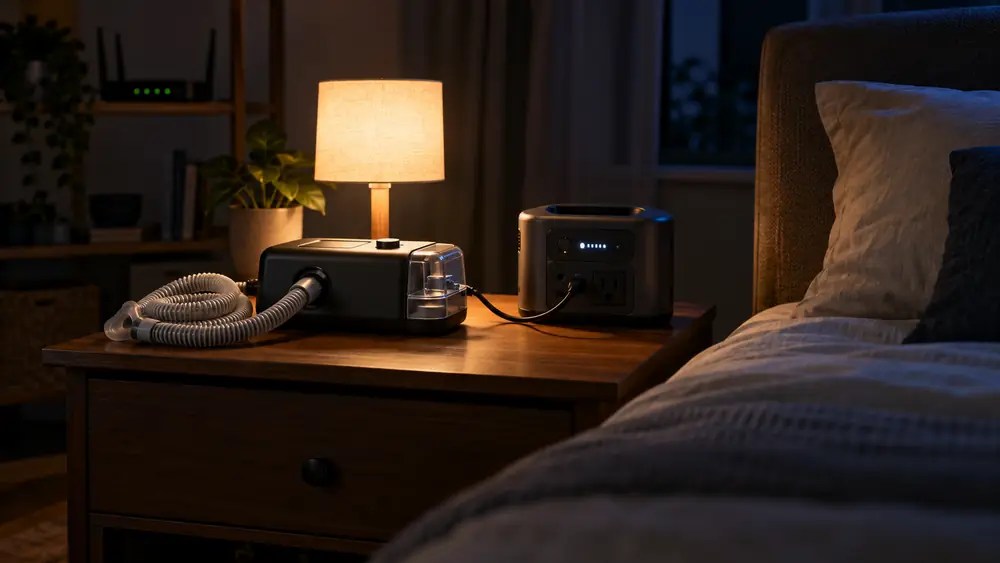
Why portable power stations run out early on small loads
By Watt Power Station · Updated
In short
On a small load: 49% to 71% of rated capacity at about 34 W, from
6 units we track.
On a bigger load: the same units
gave 76% to 90% at about 380 W, 12
to 37 points more.
Why: the station uses 9 W to 74 W on itself, in the figures we
hold for 10 units. Over an 8-hour night that is 72 Wh to
594 Wh before your device gets any.
Best in our small-load data:Goal Zero Yeti 700,
71% at about 34 W, with about 9 W used on itself.
Run time: usable Wh ÷ (your device's watts + the station's own watts).
They run out early because the power station uses power too. Its electronics and its AC inverter draw power the whole time it is on.
On a big load that is a small slice. On a small load, such as a CPAP, a router, a fan or a few lights, it is a big
one. In Outdoor Life's tests at about 34 W, the 6 units we track delivered 49% to
71% of their rated capacity. At the heavier loads we count, the median is 86%.
How much capacity do you lose on a small load?
A lot. Outdoor Life ran 6 units we track
twice, each until it shut off: once at about 34 W and once at about 380 W. Here are the results,
best on the small load first.
Share of rated capacity each unit delivered on a small and a bigger load, same tester
Percentages are the share of the rated (box) capacity each unit delivered before it shut off. "Points" is the gap
between the two results. Dates and links are in the sources below.
In energy terms, the Jackery Explorer 1000 Plus gave 470 Wh less on the
small load than on the bigger one, from a 1,264 Wh battery. Across all the models we
track, usable capacity at the heavier loads we count runs from 75% to 96% of rated.
Real capacity table
Why does a small load drain the battery faster than expected?
Because the station's own use doesn't shrink with your load. Much of it stays about the same whatever you plug in,
so the smaller the load, the bigger the share the station keeps for itself.
Take the EcoFlow DELTA 3. Outdoor Life measured its
idle draw at about 16 W:
On a 380 W load, 16 W is about 4% of the total.
On a 34 W load, it is about 32% of the total.
That is why a station can test well at a few hundred watts and still fall short overnight on a CPAP or a router.
Every unit also loses some energy turning battery power into wall power, at any load.
How much power does a portable power station use on its own?
Between 9 W and 74 W, in the figures we hold for 10 units we track.
Testers measure it in two ways:
Idle draw: the station switched on with nothing plugged in. Outdoor Life, The Solar Lab and Hobotech
publish this.
During CNET's fridge test: CNET published how much
of each battery went on the station itself. We turned that into watts with CNET's run time.
Power each portable power station uses on itself, lowest first
"Share of a 34 W run" is our estimate: the station's own watts ÷ (34 W + its own watts). The
night figure is the own use × 8 hours, against the unit's usable capacity.
A good result on a big load tells you little about small loads. The Anker SOLIX C2000 Gen 2 and
the Oscal PowerMax 2400 delivered 89% and
90% of rated capacity in independent tests.
On CNET's fridge, the
Oscal PowerMax 2400 used 6 times as much on itself.
How do I work out the run time for a small load?
Three steps:
Find your device's watts. The label or power adapter gives the most it can draw, which is often more
than it uses. A plug-in watt meter gives the real figure: run the device for a few hours, then divide the Wh by the
hours.
Add the station's own use. Use the table above. If your model isn't in it, the middle of our figures
is about 21 W.
Divide the station's usable capacity by the total. Usable capacity is what the unit delivered in
independent tests at normal loads. Every review page shows it.
Worked example: the EcoFlow DELTA 3 has 885 Wh usable and uses about
16 W on itself. On a 34 W load: 885 ÷ (34 +
16) = about 17.7 hours. Outdoor Life's run works out to about
15.6 hours (530 Wh at about 34 W).
We can check the sum wherever we hold both an idle figure and a small-load run for the same unit:
EcoFlow DELTA 3: our sum 17.7 hours, measured about 15.6 hours.
How long will a portable power station run a CPAP machine?
We don't publish CPAP run times yet. We hold no tested CPAP run. We will only estimate one from a CPAP maker's own
power figure, once we have checked it. You can work out your own in a few minutes:
Measure your CPAP for one night. Plug it into a watt meter at your usual settings, with the
humidifier and heated tube set the way you use them. Divide the Wh by the hours you slept. Your CPAP's manual may also
give a power figure.
Add the station's own use from the table above, or about 21 W if your model isn't in it.
Divide usable capacity by the total for the hours of run time. Divide that by the hours you sleep for
the number of nights.
Leave a margin. Our sum landed within about 15% of measured run times.
Once you have your CPAP's watts, add it as your own device in the run-time calculator.
If your CPAP maker sells a DC cable or converter for your machine, it can run from the station's 12 V car outlet with
the AC outlets off. The next section shows what that can save. If you depend on your CPAP, test a full night at home
before you need it.
Does using the DC outputs instead of AC help?
It can, by a lot. Hobotech measured the EcoFlow DELTA Pro 3 with nothing plugged in, both ways:
AC outlets on: about 49 W (195 Wh over 4 hours, at 120 V).
DC outputs only: about 13 W (151 Wh over 12 hours).
Over an 8-hour night, the difference comes to about 290 Wh.
We hold this comparison for one unit only, so the saving will be different on others.
What you can do:
Run small devices from USB-C or the 12 V car outlet when they can. If a device's wall adapter puts out 12 V or USB
power, a matching cable can run it from the station's DC outputs.
Turn the AC outlets off when nothing needs them.
Switch the station off when you're done. Its own use carries on whether or not anything is plugged in.
For a CPAP, use the maker's DC cable or converter if there is one for your machine.
Which portable power stations do best on small loads?
Going by the small-load and own-use figures we hold, these stand out. Each comes straight from the tables above.
We may earn a commission from the store links below; it never changes our figures. How we make money
Weakest in our small-load data: the Jackery Explorer 1000 Plus. It delivered
49% at about 34 W, the lowest of the 6. The Oscal PowerMax 2400 used
about 74 W on itself in CNET's fridge test. That
is the most of any model we have a figure for.
Why don't your rankings use the small-load results?
Because a test under 100 W measures the station's own use as much as its battery. We keep those results, but
out of the usable capacity figure and the scores. You can still find them:
On review pages: each small-load result has a box of its own.
Outdoor Life, Jan 9, 2026: small-load and heavier-load runs for the Goal Zero Yeti 700, Anker SOLIX C1000 (first gen), OUPES Mega 1, EcoFlow DELTA 3 and Jackery Explorer 1000 Plus; idle draw for the Goal Zero Yeti 700 and EcoFlow DELTA 3.
Outdoor Life, May 5, 2025: small-load and heavier-load runs for the BLUETTI AC180.
CNET, Jul 23, 2026: fridge run times and the share each station used on itself, for the Anker SOLIX C2000 Gen 2, BLUETTI FridgePower, Jackery HomePower 3000, Anker SOLIX F3000 and Oscal PowerMax 2400.
The Solar Lab, page undated: idle draw for the Dabbsson 600L.
The Solar Lab, page undated: idle draw for the Dabbsson 2000L.
Hobotech, Jun 26, 2024: idle draw for the EcoFlow DELTA Pro 3.
Our sums: the station's own watts in the fridge test are the tester's measured Wh × the share it used on itself ÷ the
run time. Run time on a small load is the tester's Wh ÷ the load. Run time from our sum is usable Wh ÷ (load + own
watts).
Usable capacity: the median of the tests we count for each model, which leaves out loads under 100 W.
How we count tests
We record testers' numbers only. The testing, the write-ups and any photos belong to them.
How we test and rank