Shortest: Oscal PowerMax 2400, 12.58 hours.
It used 55.41% of its energy on itself.
Size for a full day: about 1,600 Wh to 2,200 Wh of usable capacity, for a fridge
like CNET's.
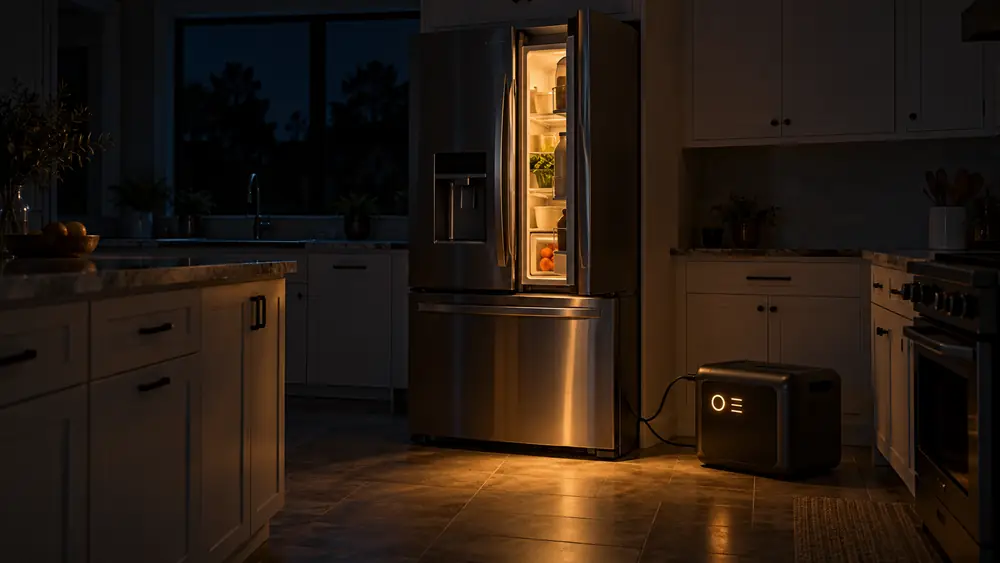
A large portable power station can keep a full-size refrigerator running for about a day. In CNET's lab test,
the 10 models we track ran the same fridge for 12.58 to 38.58 hours. Battery
size is only part of the story. The power a station spends on itself decides how much reaches the fridge.
How long will a portable power station run a refrigerator?
About a day for most large units: 8 of the 10 we track lasted 20 hours or more. CNET ran
19 large and extra-large power stations on one fridge until each was empty. The fridge was a full-size Whirlpool refrigerator (118 V, 60 Hz, rated 7.2 A at full load).
CNET published the results on Jul 23, 2026. Here are the models we track, longest first.
Fridge run time for each portable power station we track, from CNET's test
"Used on itself" is CNET's figure for the share of the battery that went on keeping the station's own inverter and
electronics running. "Price per fridge hour" is the brand-store price we checked, divided by the run time.
CNET also tested 9 units we don't track yet. The longest of all 19 was the Fossibot 3600 Pro at
44.65 hours (1.9 days).
Why doesn't a bigger battery always last longer?
Because the power station uses power too. A fridge's compressor switches on and off, so for much of the test the
station feeds a small load. Its inverter stays on the whole time, and that costs energy every hour.
From CNET's figures we can split each battery's energy between the fridge and the station (7 units):
The fridge used 54 W to 60 W on average in every one of those tests.
The station itself used anything from 12 W (Anker SOLIX C2000 Gen 2) to
74 W (Oscal PowerMax 2400).
Bigger isn't always longer. The Anker SOLIX F3000 has
50% more battery than the
Anker SOLIX C2000 Gen 2 but ran the fridge only 1.57 hours longer. It used
37.81% of its energy on itself, against 18.21%.
Good capacity, poor fridge time. The Oscal PowerMax 2400 delivered
90% of its rated capacity in CNET's 480 W test. On the fridge, it spent more
on itself than on the fridge.
Our light-load data shows the same effect.
At a 34 W load, Outdoor Life got 49% to 71% of rated capacity from the 6 units we track that it tested.
At the heavier loads we count, the models we track deliver 75% to 96%. How we count tests
What size power station do I need for a refrigerator?
Size it on usable capacity, not the number on the box. In CNET's test, 7 of the 8 models we
track with a CNET capacity figure used 66 Wh to 91 Wh for each hour the fridge ran.
The Oscal PowerMax 2400 used 134 Wh. For a fridge like CNET's, that
means:
Half a day (12 hours): about 800 Wh to 1,100 Wh usable.
A full day (24 hours): about 1,600 Wh to 2,200 Wh usable.
Two days (48 hours): about 3,200 Wh to 4,400 Wh usable.
Usable capacity is what a unit delivers in independent tests. Every review page shows it, and the
real capacity table lists all of them. Your fridge may use more or less than CNET's, so
the next section shows how to work it out.
How do I work out the run time for my own fridge?
Three steps, with a worked example:
Find your fridge's average watts. Take the kWh per year from its yellow EnergyGuide label or its
manual, and divide by 8.76. For example, 500 kWh a year ÷ 8.76 = 57 W.
Add the station's own use. In CNET's test it ran from 12 W to
74 W. If you don't know a model's figure, the middle of CNET's results was about 31 W.
Divide usable capacity by the total. The Anker SOLIX C2000 Gen 2 has 1,812 Wh usable and
uses about 12 W itself: 1,812 ÷ (57 + 12)
= about 26.2 hours. On CNET's fridge, which used a little less, it ran for 27.40 hours.
Real use often runs higher than the label, because door openings and a warm room add to it.
Can a portable power station handle a fridge's start-up surge?
Yes, at these sizes. A compressor draws a short burst of extra power each time it starts. All 19 units in
CNET's test started and ran its fridge, which is rated at 7.2 A at 118 V (about
850 W at full load).
Every model in our table is rated for at least 1,800 W of continuous output.
For your own fridge, find its amps on the rating label or in the manual. Multiply by 120 for watts, and compare that
with the station's continuous and surge ratings. Every review page lists both.
Do I need a UPS mode to run a fridge?
Not to run it, but it helps if the fridge stays plugged into the station. In UPS (pass-through) mode the fridge runs
from the wall, and the station takes over when the power goes out. Nobody needs to be home to switch it.
9 of the 10 models in our table list a UPS mode in their US manuals, with switchover times of
10 to 20 milliseconds.
We couldn't check the Oscal PowerMax 2400.
Each review page gives the switchover time and links to the manual.
How long does food stay safe without power?
Not long without a backup.
FoodSafety.gov
gives these limits:
Refrigerator: up to 4 hours, if you keep the door closed.
Full freezer: about 48 hours, or 24 hours if it is half full.
Every unit in CNET's test ran the fridge for at least 12.58 hours, more than 3 times
the 4-hour limit.
Which portable power station is best for a refrigerator?
It depends on how long you need to cover and what you want to spend. These picks come straight from the table.
We may earn a commission from the store links below; it never changes our figures. How we make money
Skip for a fridge: the Oscal PowerMax 2400. It ran the fridge for 12.58 hours, the
shortest of any model we track.
Can I run a mini fridge or a 12 V car fridge instead?
We don't have tests for those yet. A 12 V compressor fridge can run from a station's 12 V car outlet. That skips the
inverter, which is where much of the overhead above comes from.
Sources and how we worked it out
CNET's fridge test, published Jul 23, 2026: run times, and the
share of energy each station used on itself.
CNET's portable power station list: the 480 W capacity
figures, and the "used on itself" figures for the Jackery HomePower 3000, Anker SOLIX F3000 and Oscal PowerMax 2400.
FoodSafety.gov:
how long food stays safe in a power outage.
Our sums: the fridge's average watts are CNET's measured Wh, minus the station's share, divided by the run time.
Battery used per hour is CNET's measured Wh divided by the run time.
Prices: each brand's US store, checked by hand on the date shown on each review page.
We record CNET's numbers only. The testing, the write-up and any photos belong to CNET.
How we test and rank